
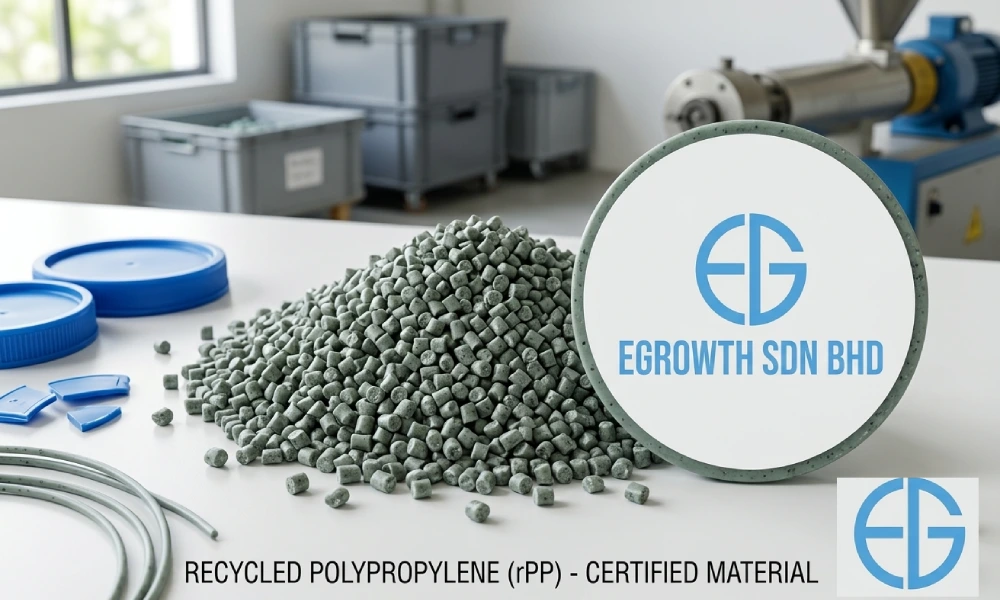
Polypropylene is one of the most widely used plastics in the world. It is in the packaging around your food, the crates in your warehouse, the bumper of your car, the chair you are sitting on, and the carpet beneath your feet. Its properties lightweight, chemically resistant, heat tolerant, and mechanically capable make it useful in an almost endless range of applications. And because it is used everywhere, it is discarded everywhere.
For decades, the story of polypropylene waste ended at a landfill or an incinerator. The material was treated as a single-use input, and the energy and resources that went into producing it were written off at the point of disposal. The recycled polypropylene industry has fundamentally changed that equation. What was waste is now a raw material one that enters a carefully managed process and exits as uniform, consistent pellets ready to be processed exactly as virgin resin would be.
This guide follows that process from start to finish: how polypropylene waste is collected and sorted, what happens inside a recycling facility, how the material is cleaned and converted, and what the finished recycled pellet actually represents for the manufacturers and brands choosing to build it into their supply chains.
Where the Waste Comes From Feedstock Collection
The quality of recycled polypropylene begins long before any processing takes place. It begins with the collection and sorting of the waste material that will become the feedstock. The type of waste collected, and how cleanly it has been segregated before it reaches the recycling facility, determines the ceiling on what the finished pellet can achieve.
Polypropylene waste enters the recycling stream from several distinct sources. Post-consumer waste material that has been used by an end consumer and discarded includes packaging films, food containers, caps and closures, household items, and woven sacks. Post-industrial waste, sometimes called pre-consumer waste, includes off-cuts, trim waste, rejected components, and production scrap generated during manufacturing processes. Industrial waste is generally cleaner, more uniform in grade and colour, and easier to process consistently than post-consumer material.
The source matters enormously to anyone buying recycled polypropylene for a specific application. A recycled polypropylene supplier working primarily with clean post-industrial regrind from a single polymer stream can deliver material with tightly controlled properties. A recycler working with mixed post-consumer packaging waste will produce a wider range of material grades with more variable properties unless their sorting and separation process is particularly sophisticated.
Sorting and Identification Getting the Polymer Right
Polypropylene is one polymer in a family of plastics that look similar but behave very differently when processed together. Mixed plastic waste material containing polypropylene alongside polyethylene, PET, PVC, and other polymer types cannot be processed into a useful recycled material without first separating the individual polymers.
Manual Sorting
The first pass through most recycling facilities is manual. Workers on a sorting line remove obvious contaminants non-plastic materials, large foreign objects, heavily soiled items and identify gross misclassifications in the incoming stream. Manual sorting is effective for large, easily identifiable items but cannot differentiate between polymer types at scale or speed.
Near-Infrared Spectroscopy Sorting
Near-Infrared (NIR) spectroscopy is the technology that makes modern high-quality plastic recycling possible at industrial scale. NIR sorting machines illuminate incoming material with near-infrared light and analyse the reflected spectrum in real time. Each polymer type has a characteristic spectral signature, and the machine can identify polypropylene, separate it from other polymers, and divert it to the correct stream using high-speed air jets all within milliseconds and at conveyor belt speeds that manual sorting cannot match.
A well-configured NIR sorting line can achieve polypropylene purity levels above 95% from mixed plastic inputs. For recycled polypropylene manufacturers supplying applications that demand consistent material properties, this level of polymer purity at the input stage is the foundation of output quality.
Density Separation
Water-based density separation sometimes called float-sink separation is another tool in the sorting process. Polypropylene has a density below 1 g/cm³, which means it floats in water. PET, PVC, and many other polymers sink. By running shredded material through a water bath, polypropylene can be separated from denser polymers with high efficiency. This step is particularly useful as a secondary separation after NIR sorting, catching contamination that optical sorting may have missed.
Washing and Contamination Removal
Sorted polypropylene waste arrives at the washing stage carrying varying levels of contamination food residue, labels, adhesives, inks, oils, and surface dirt. The washing process must remove these contaminants thoroughly without degrading the polymer itself.
Industrial washing systems for polypropylene recycling typically involve a multi-stage sequence. The material is first shredded or granulated into smaller pieces to increase surface area for washing. It then passes through a hot caustic wash typically using heated water with detergent and alkali additives which breaks down adhesives, removes food soils, and strips label residue from the surface.
The wash water is then separated from the plastic in a centrifugal drying step, and the material passes through a rinse stage to remove washing chemical residue before the final drying process. The quality of washing directly affects the colour and odour of the finished recycled polypropylene. Material that has not been thoroughly washed will carry discolouration and odour into the extrusion stage, and those characteristics will be present in the finished pellet regardless of how well the subsequent processing steps are managed.
Washing efficiency is one of the clearest differentiators between recycled polypropylene manufacturers. A facility with a single cold wash stage produces a different quality of input to the extruder than one with a multi-stage hot wash system. For buyers sourcing recycled PP for applications where colour consistency or odour performance matters, the washing process of their potential supplier is worth investigating specifically.
Extrusion and Palletisation Turning Flake Into Pellet
After washing and drying, the clean polypropylene flake or granulate is ready for the step that converts it from a recycled fragment into a process able raw material. This is the extrusion stage the point at which the material takes on the form in which it will be sold and used.
The cleaned flake is fed into a single-screw or twin-screw extruder. Inside the extruder barrel, the material is progressively heated, compressed, and melted into a viscous polymer melt. The twin-screw extruder has a particular advantage in recycling applications: its twin rotating screws provide intensive mixing and can incorporate additives stabilisers, colorants, compatibilisers, and performance modifiers uniformly into the melt stream in a way that single-screw systems cannot always match.
As the melt exits the extruder through a die, it forms continuous strands. These strands are either cooled in a water bath before being cut into pellets by a strand pelletiser, or they are cut directly at the die face in an underwater pelletising system a method that produces particularly uniform pellet geometry and is favoured by manufacturers supplying applications with tight dimensional consistency requirements.
The pellets are then dried, screened to remove fines and oversized particles, and transferred to bulk bags or silo storage ready for quality testing and despatch.
Quality Control and What the Finished Pellet Represents
A finished recycled polypropylene pellet is not simply melted and re-solidified plastic. It is a material that has been characterised, stabilised, and in the hands of a competent recycled polypropylene manufacturer produced to a defined specification with documented properties.
Standard quality parameters tested on finished recycled PP pellets include melt flow index (MFI) which indicates how the material will behave during injection moulding, extrusion, or blow moulding tensile strength, elongation at break, impact resistance, and colour. Additive packages added during extrusion compensate for the thermal degradation that occurs each time polypropylene is processed, restoring the material’s processing stability to levels appropriate for its intended application.
The range of quality achievable in recycled polypropylene is wide. At the lower end, material produced from mixed post-consumer waste without rigorous sorting and washing may be suitable for injection moulded parts where appearance and performance consistency are not priorities. At the higher end, material produced from clean post-industrial waste with full NIR sorting, multi-stage hot washing, and twin-screw compounding with stabiliser packages can meet specifications close to virgin grades and is being used in exactly those applications by manufacturers who have made sustainability commitments but cannot sacrifice product performance.
For a buyer evaluating a recycled polypropylene supplier, the quality of the process described above is reflected directly in the technical data sheet of the material being offered. An MFI value, a tensile strength figure, and an impact value are only meaningful if the process behind them is consistent enough to reproduce those properties batch after batch.
The journey from a discarded polypropylene container to a finished recycled pellet is a technically serious process not a simple clean-and-melt operation but a multi-stage engineering sequence where decisions made at each step determine the quality and consistency of the material that enters a manufacturer’s production process.
Understanding this process gives buyers a meaningful framework for evaluating the recycled polypropylene they source. The right questions to ask a potential supplier about feedstock sources, NIR sorting capability, washing system design, extruder type, and quality testing protocols all flow naturally from understanding what happens between waste collection and finished pellet.
Recycled polypropylene is not a compromise material. It is a technical product that, when made properly, performs as a genuine alternative to virgin resin. The suppliers worth working with are those who can explain exactly how they make it.
