
Plastic is everywhere in the packaging on your desk, the components inside your car, the pipes running through your building, the medical devices in hospitals, and the crates moving goods through supply chains across the world. Every one of those products started as a design file and a material specification in someone’s hands, and then found its way to a manufacturing facility capable of turning raw resin into a finished, functional product.
In Malaysia the combination of a large domestic market, a skilled workforce, competitive production costs, and a well-developed raw material supply chain has attracted investment from domestic brands and international buyers alike. For businesses sourcing plastic products whether components, packaging, consumer goods, or industrial items offers a depth of manufacturing capability that few countries can match at comparable price points.
But the market is also uneven. The gap between a well-run plastic product manufacturer with documented quality systems and an informal operation working from outdated equipment and unverified materials is significant and not always visible from a catalogue or a price quotation. This guide gives buyers the knowledge to tell the difference.
Plastic Manufacturing Landscape
Plastic processing industry handles millions of tonnes of plastic annually, spread across thousands of manufacturing units ranging from small family-run operations to large integrated facilities producing for export markets.
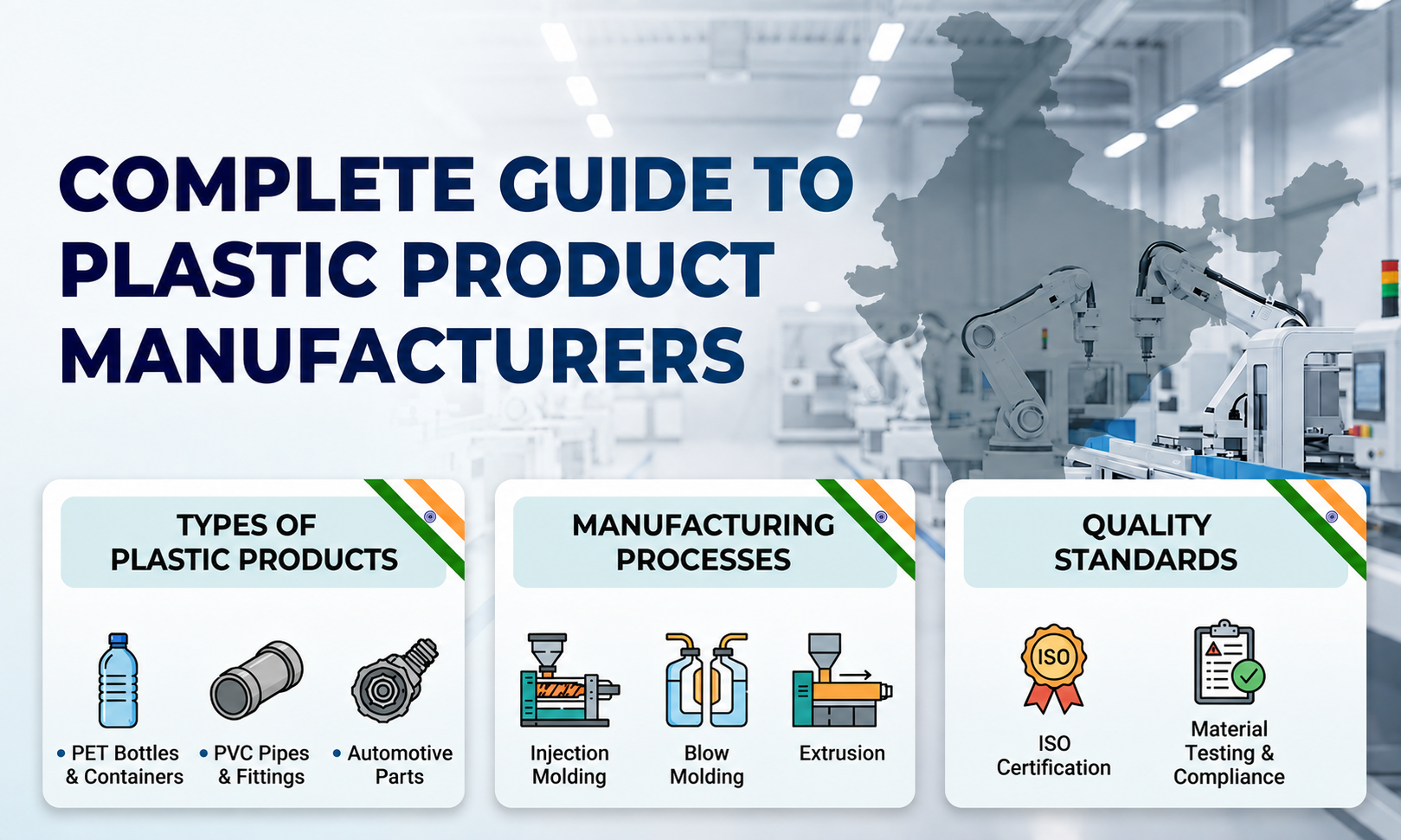
The Main Manufacturing Processes and When Each One Applies
Injection Moulding
Injection moulding is the most widely used plastic manufacturing process globally and the backbone of plastic product manufacturing sector. Molten plastic resin is injected under high pressure into a precision-machined mould, cooled, and ejected as a finished part. The process is highly repeatable, capable of tight dimensional tolerances, and economical at medium-to-high volumes once the mould tooling cost is absorbed.
Injection moulding is appropriate for a vast range of products from tiny precision components to large automotive panels, from single-use packaging closures to durable industrial parts. The design flexibility within injection moulding is considerable: wall thickness, rib structures, snap-fit features, and surface textures can all be incorporated into the mould design. The key constraint is that each product requires its own mould a capital cost that ranges from a few thousand ringgit for a simple single-cavity tool to several tens of thousands ringgit for a complex multi-cavity precision mould.
Blow Moulding
Blow moulding produces hollow plastic products bottles, containers, tanks, and jerricans by inflating a heated plastic parison (a tube of molten plastic) inside a mould until it takes the shape of the mould cavity. The process is used for packaging applications across the FMCG, chemical, pharmaceutical, and food industries, as well as for larger industrial containers and fuel tanks.
The most important distinction between injection moulding and blow moulding for buyers is the type of product each produces. If the product needs to be hollow a bottle, a container, a duct blow moulding is the correct process. If it is a solid or thin-walled structural component, injection moulding is appropriate. A plastic product manufacturer operating both processes is better placed to advise on the correct approach for a given design than one with only a single process capability.
Rotational Moulding
Rotational moulding also called rotomoulding produces large, hollow plastic products with uniform wall thickness. A measured charge of plastic powder is loaded into a mould, which is then heated in an oven while rotating on two axes. The plastic melts and coats the inside of the mould uniformly, producing a hollow form that is then cooled and removed.
Rotomoulding is the go-to process for water tanks, storage bins, large agricultural containers, kayaks, playground equipment, and any product that is too large or complex in its hollow geometry for blow moulding. Manufacturers producing polyethylene tanks and containers in capacities from a few hundred litres to tens of thousands of litres.
Thermoforming and Extrusion
Thermoforming heats a plastic sheet until pliable and then forms it over a mould using vacuum, pressure, or mechanical assistance. It is widely used for food packaging trays, blister packs, and disposable containers where thin-wall products are needed at high speed and low tooling cost. Extrusion produces continuous plastic profiles pipes, sheets, films, tubes, and channels by pushing molten plastic through a shaped die.
Raw Materials Why the Plastic Resin Specification Matters
The finished plastic product is only as good as the resin that went into making it. The plastic resin manufacturer who supplied the raw material, and the grade of resin selected for the application, determine the mechanical properties, chemical resistance, temperature performance, and regulatory compliance of every product that comes out of the mould.
Common Resin Types and Their Applications
High-Density Polyethylene (HDPE) is one of the most widely processed resins. It offers good chemical resistance, low moisture absorption, and acceptable impact strength across a wide temperature range. It is the standard material for pipes, containers, industrial tanks, and a wide range of packaging applications. Food-grade HDPE is used for bottles, caps, and food contact packaging.
Polypropylene (PP) offers higher stiffness than HDPE at equivalent wall thickness and better performance at elevated temperatures. It is the dominant material in automotive interior components, household goods, food containers, and industrial crates. Copolymer PP grades offer improved impact resistance in cold conditions, making them suitable for packaging used in refrigerated supply chains.
ABS (Acrylonitrile Butadiene Styrene) is an engineering plastic with good surface finish, dimensional stability, and moderate impact resistance. It is widely used in consumer electronics housings, automotive interior trim, and any application where surface appearance and dimensional precision are important.
PVC (Polyvinyl Chloride) is used extensively for pipes, window profiles, cable insulation, and flooring products. Its chemical resistance and flame-retardant properties make it the material of choice for construction and electrical applications, though food contact applications require verified food-grade compound specifications.
When evaluating a plastic product manufacturer, always ask for the specific resin grade not just the generic material type. The difference between a food-grade PP and a standard PP, or between a UV-stabilised HDPE and an unstabilised grade, is not visible in the finished product but is significant in terms of performance and regulatory compliance.
Quality Standards and Certifications to Verify
ISO 9001 Quality Management
ISO 9001 is the international standard for quality management systems. A plastic product manufacturer holding ISO 9001 certification has documented production processes, defined quality checkpoints, and a system for identifying and correcting non-conformances. For buyers sourcing at volume, this certification is the baseline assurance that production quality is managed systematically rather than informally.
Food Grade and Medical Grade Compliance
For any plastic product that will contact food or pharmaceutical products, material compliance is non-negotiable and legally required. Food grade plastics must be manufactured from resins on the approved lists of the relevant regulatory authority FDA in the US, EFSA in Europe. Medical grade plastics have additional requirements around biocompatibility, sterilisation compatibility, and extractables.
A credible plastic product manufacturer supplying food or medical applications should be able to provide material safety data sheets, resin compliance declarations, and migration test results specific to the application not just a verbal assurance that the material is “food safe.”
How to Evaluate and Source From the Right Manufacturer
Start With a Detailed Product Specification
Before approaching any manufacturer, document your requirement completely: the product dimensions and tolerances, the material specification including grade and any additives required, the required certifications, the expected annual volume, the packaging format, and any testing or inspection requirements. The more complete your specification, the more meaningful the quotations you receive and the easier the supplier comparison becomes.
Visit the Facility or Commission an Audit
A factory visit is the single most revealing step in supplier evaluation. Walk the production floor. Observe whether incoming resin is tested and labelled with material certificates. Check whether the moulding machines are maintained and whether process parameters are displayed and monitored. Look at how finished goods are inspected before dispatch. A plastic product manufacturer who welcomes this kind of scrutiny and can answer questions about their process confidently is demonstrating exactly the kind of operational discipline that produces consistent product quality.
For buyers who cannot visit in person, commissioning a third-party factory audit through an inspection agency is a practical alternative. The audit report provides an independent assessment of the facility’s quality management systems, equipment condition, and compliance documentation.
Verify Raw Material Sourcing
Ask prospective manufacturers where they source their plastic resin. A manufacturer who buys from recognised plastic resin manufacturers established domestic producers or reputable importers and can provide material test certificates for every incoming batch is operating at a different standard from one who buys on price from whoever is cheapest that week.
Resin quality directly affects product consistency. Manufacturers who take incoming material quality seriously tend to produce finished goods that perform predictably across batches. Those who do not create exactly the kind of batch-to-batch variation that causes problems for buyers with tight product specifications.
Conduct Sample Testing Before Committing to Volume
Request production samples not prototype samples made specially for the quotation and have them tested by an independent laboratory against your specification. Key tests depend on the application: tensile strength and impact resistance for structural parts, migration testing for food contact products, dimensional accuracy for precision components, UV resistance for outdoor applications.
The cost of sample testing is trivial compared to the cost of discovering a quality problem after a full production run has been completed and shipped.
Plastic manufacturing sector offers genuine capability at every level of the market from commodity packaging produced at the lowest possible cost to precision engineered components manufactured to exacting international standards. The buyers who navigate this market successfully are those who invest the time to specify correctly, verify credentials independently, and build supplier relationships on the basis of demonstrated quality rather than the most attractive headline price.
A well-chosen plastic product manufacturer becomes a long-term operational partner one whose consistent quality, reliable delivery, and technical responsiveness contribute directly to the competitiveness of everything your business produces or sells. Finding that partner takes more effort than a quick search and a price comparison. It is effort that pays back across every order placed.
