
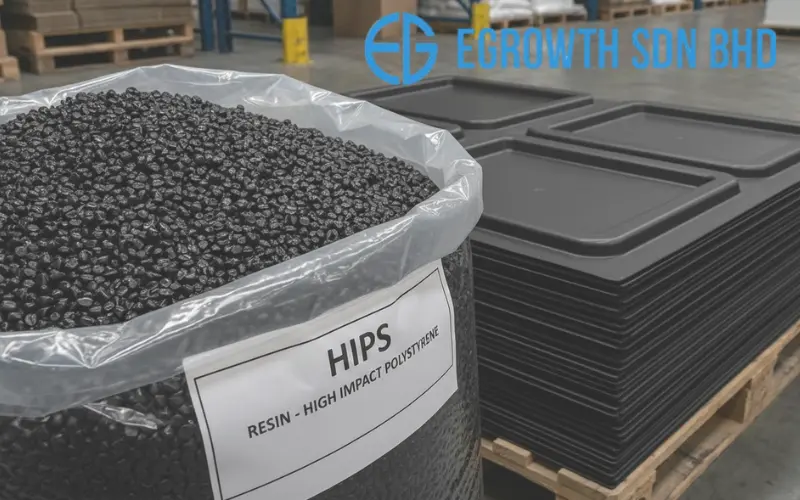
In the realm of industrial manufacturing, High Impact Polystyrene (HIPS) stands out as a versatile thermoplastic polymer, particularly in its black variant. HIPS Black, known for its durability and aesthetic appeal, is widely used in applications ranging from consumer electronics to automotive components. Understanding the processing parameters for HIPS Black is crucial for manufacturers aiming to optimize production efficiency, product quality, and cost-effectiveness. This comprehensive guide explores the key processing parameters for HIPS Black, offering insights into techniques like injection molding, extrusion, and thermoforming. By mastering these parameters, industries can achieve superior results while minimizing defects and waste.
What is HIPS Black and Its Significance in Industrial Production?
High Impact Polystyrene (HIPS) is a copolymer of styrene and butadiene, engineered for enhanced toughness and impact resistance compared to standard polystyrene. The “Black” designation refers to HIPS compounded with carbon black or other pigments, providing UV stability, opacity, and a sleek appearance. This makes HIPS Black ideal for products requiring a matte, non-reflective finish, such as housings for appliances, toys, and packaging.
In industrial production, HIPS Black’s low cost, ease of processing, and recyclability make it a go-to material. However, its processing parameters must be carefully controlled to avoid issues like warping, brittleness, or discoloration. Factors such as temperature, pressure, and cooling rates play pivotal roles in determining the final product’s integrity. As industries shift towards sustainable practices, optimizing processing parameters for HIPS Black also supports energy-efficient manufacturing.
Key Properties of HIPS Black Affecting Processing
Before diving into parameters, it’s essential to understand HIPS Black’s material properties. It boasts a density of 1.03-1.05 g/cm³, a melt flow index (MFI) of 4-20 g/10 min, and a glass transition temperature (Tg) around 100°C. The black pigmentation enhances thermal stability and reduces degradation under UV exposure. These properties influence processing: for instance, its low viscosity allows for easy flow, but high thermal sensitivity requires precise temperature control to prevent degradation.
In industrial settings, HIPS Black is processed via methods like injection molding, extrusion, and thermoforming. Each method demands tailored parameters to leverage its strengths, such as impact resistance and moldability, while mitigating weaknesses like poor chemical resistance.
Injection Molding Parameters for HIPS Black
Injection molding is the most common technique for producing HIPS Black parts, especially for complex geometries. The process involves melting the polymer and injecting it into a mold under pressure. Key parameters include:
Temperature Settings: Barrel temperatures should range from 180-250°C, with the nozzle at 200-220°C. Overheating can cause thermal degradation, leading to yellowing or reduced impact strength. For HIPS Black, maintaining a melt temperature of 210-230°C ensures optimal flow without pigment burn-off.
Injection Pressure and Speed: Use pressures of 50-100 MPa, with injection speeds of 50-100 mm/s. High speeds prevent premature cooling, but excessive pressure can cause flash or sink marks. For thick-walled parts, slower speeds are preferable to allow even filling.
Mold Temperature: Keep molds at 20-60°C. Cooler molds (around 30°C) promote faster cycle times and better surface finish, while warmer ones reduce internal stresses. For HIPS Black, a mold temperature of 40-50°C balances dimensional stability and gloss.
Cooling and Cycle Time: Cooling times of 20-40 seconds are typical, with total cycle times under 60 seconds for efficiency. Rapid cooling minimizes warping, a common issue with HIPS due to its thermal expansion coefficient.
Optimizing these parameters in injection molding for HIPS Black can yield parts with high gloss, minimal shrinkage (0.4-0.7%), and excellent impact resistance. Manufacturers often use computer-aided engineering (CAE) software to simulate and refine settings.
Extrusion Parameters for HIPS Black
Extrusion is vital for producing sheets, profiles, and films from HIPS Black, commonly used in signage, packaging, and construction. The process melts the polymer and forces it through a die.
Temperature Profile: Extruder zones should be set at 160-220°C, with the die at 180-200°C. A gradual temperature increase prevents shear degradation. For HIPS Black, maintaining uniformity avoids pigment agglomeration, which could affect color consistency.
Screw Speed and Pressure: Operate at screw speeds of 50-150 rpm, with back pressures of 5-20 MPa. Higher speeds improve throughput but risk overheating. Vacuum venting is recommended to remove volatiles, enhancing product clarity.
Die and Cooling: Use dies with polished surfaces for smooth finishes. Cooling in water baths at 10-20°C ensures dimensional accuracy. For films, air cooling at controlled humidity prevents static buildup.
Output and Quality Control: Aim for outputs of 100-500 kg/h, depending on equipment. Regular checks for thickness uniformity and impact strength are essential, as extrusion parameters for HIPS Black directly influence mechanical properties.
In industrial production, extrusion of HIPS Black is favored for its scalability, making it cost-effective for large-volume runs.
Thermoforming Parameters for HIPS Black
Thermoforming shapes HIPS Black sheets into products like trays and covers. It’s a heat-and-form process ideal for lightweight applications.
Heating Temperature: Preheat sheets to 140-160°C, just above Tg, for 20-40 seconds. Uniform heating prevents sagging or uneven forming. For HIPS Black, infrared heaters provide precise control to maintain pigmentation integrity.
Forming Pressure and Speed: Apply vacuum or pressure forming at 0.1-0.5 MPa. Forming speeds of 10-50 mm/min ensure detail reproduction without tearing. Drape forming is common for simple shapes.
Cooling and Trimming: Cool formed parts at room temperature or with fans. Trimming excess material post-forming requires sharp tools to avoid cracking.
Thermoforming parameters for HIPS Black are less intensive than molding, but they demand attention to sheet thickness (0.5-3 mm) for optimal results.
Challenges in Processing HIPS Black and Mitigation Strategies
Processing HIPS Black isn’t without hurdles. Common issues include warping due to differential cooling, brittleness from over-drying, and color fading from UV exposure. To mitigate:
Drying: Dry pellets at 70-80°C for 2-4 hours to remove moisture, preventing hydrolysis and bubbles.
Additives and Blends: Incorporate stabilizers for UV resistance. Blending with other polymers can enhance properties, but test compatibility.
Equipment Calibration: Use advanced machinery with sensors for real-time monitoring. Regular maintenance reduces downtime.
By addressing these, manufacturers can achieve consistent quality in HIPS Black production.
Applications and Best Practices in Industrial Production
HIPS Black finds use in electronics casings, automotive interiors, and furniture due to its affordability and aesthetics. Best practices include:
Sustainability: Opt for recycled HIPS Black to align with eco-goals, reducing processing energy by 10-20%.
Quality Assurance: Implement ISO standards for testing. Batch traceability ensures reliability.
Innovation: Explore co-extrusion for multi-layered products, expanding applications.
Mastering processing parameters for HIPS Black empowers industrial producers to create durable, cost-effective products. From precise temperature control in injection molding to optimized cooling in extrusion, these parameters drive efficiency and quality. As demand for sustainable materials grows, refining HIPS Black processing will remain key to competitive manufacturing.
